
Over recent months we have had pages and pages of coverage, speculation and comment about the end of the Kier reign and the Coming of Andy Burnham yet hardly any major coverage of an evil that is occurring daily in Afghanistan. Have we really become so parochial? Are we not interested, do we not care about the plight of these girls and women, our sisters in this world? Girls who can now be married even before puberty, women who are not allowed to be educated, go out on the streets and have to be covered from view? In this “be kind” world why is there so little compassion or outrage at what is happening to these women? Is it a general misogyny or is it a fear of being accused of being Islamophobic if we speak out against the Taliban? I am bewildered.
I have been reading Zahra Joya’s book The Vanishing Girl of Kabul. I urge you to read it, to wake up to what life is like under such a regime. The utter cruelty and contempt for women and girls dressed up as religious protection. It is a heartbreaking read and yet also an inspiring story of a girl who had to dress up as a boy in order to be able to continue her schooling and who has become a successful journalist determined to expose the iniquities she and others suffered.
Recently I had a enlightening conversation with an Afghan Uber driver. He spoke movingly about how he and his wife, a doctor, and two small children came to the UK and how tragic this situation is for Afghanistan. As he pointed out, if you educate women, you educate children and society because women still, even when they are working, tend to be the ones who encourage their children to read and write and do their homework. If women are not educated the whole of society suffers and poverty will ultimately be the outcome. Afghan men are already having to send more money home and earn more money because of women being deprived of jobs.
He told me that there are educated and professional women now begging on the street, risking punishment in order to eat. He told me how, without female midwives and doctors, who are no longer allowed to work, women are seen by male doctors who do not have the same experience. Also, that many men do not want their wives to be seen and treated by male doctors and so they go untreated, unsupported.
And yet the UN host representatives of the Taliban and the Iranian Government and the UK is silent in its agreement. We see Amnesty and other charities running major campaigns for other causes – Venezuela, Gaza, Japan’s earthquake, etc – but less about helping these women and girls.
It makes me wonder, if there was a revolution here in the UK and we were overtaken by an Islamist regime that required we women to wear the burqa would the world be equally silent? There are those who say why don’t the women fight back but they must be closing their eyes to what is happening in Iran and Afghanistan when women fight back – the shootings, executions, beheadings, lashes and stonings. How easy is it for women, who are not even allowed to talk to one another in the way they used to be, to fight back against guns?
Of course, this raises the thorny question of how can we help them. Western interference in other states rarely ends well and yet I remember well the pleas of Syrians asking us to go and help them, and the media is happy to post articles on how we must help the Palestinians, so why not the Afghan girls?
It’s difficult to get it right but surely there are ways and surely one is not to host representatives of a country that treats half its population in this abusive manner. Malala Yousafazi has posted a poignant message on Facebook questioning why the EU has invited members of the Taliban to Brussels to discuss a migration deal, without firstly insisting that they address the rights of women, which she describes as gender apartheid. She points out that the EU should surely be protesting against one of the worst human rights crises that exists in the world, just as the UN should not have given the Iranian Government any leadership role in their Human Rights Council. You can donate to Malala’s fund supporting the education and rights of women here https://malala.org
In Zahra Joya’s book The Vanishing Girl of Kabul she writes of how her mother and aunts were unable to read and write and so when she went to vote during the brief ‘democracy’, it was with her thumbprint. If a person is unable to read, they are unable to understand for whom they vote, unable to understand a contract that they might be required to sign that might do them or those they love ill. They are unable to read about other ways of living, other lives, of the freedoms other women in the world experience. If they are unable to go out on the street and talk to people they will not even know what is occurring in the next village, let alone in a country far away.
The women in Afghanistan and Iran never imagined life could really transform to remove their freedoms in the way they have experienced. Don’t let’s sit too complacent in our Western way of life and my goodness let’s value and protect all that we have gained over these centuries.

A month rarely goes by without a funeral these days. It’s disconcerting and sad, leaving gaps in one’s family and friendship circles, leaving questions in one’s mind about what might come next, what has gone before, and what on earth the secret of life might be. To be honest, it’s not easy, and I look back and wish that I had been more conscious of these concerns when my mother was moving through this stage of her life. And yet it is nature’s way that one is often in mid-life when parents age, and mid-life is probably the most stretching and demanding period of life’s journey: a moment where one needs to thrive in a career and yet be present and loving enough for partner and children. For me, it was a period when I was setting up my coaching business, Positiveworks, at the same time as attempting to be there enough for my sons plus endeavouring to help clients navigate their own priorities and balance of life. I remember all this as being both challenging and exhilarating.
Last month I sat quietly, with three friends, at a memorial service celebrating the life of a schoolfriend we had known some sixty years previously. We had not seen much of her since we left school, knew little of her adult life. She had ended up an actuary, we learnt, a partner in her firm, braving her way through the stereotypical beliefs of the 1960s-early 70s, that women would be expected to make the coffee, become a secretary or nurse.
As the registrar told the story of our friend’s life, she described the school we had shared, Cranborne Chase, as “progressive and Bohemian” and we listened, exchanged glances, reflected. Three women, when we thought about it, who had done more with our lives than any teacher had ever expected, for expectations were so incredibly low of women of our generation.
Sitting there, hearing about our friend, took us back down the journey of our lives, images and emotions unfolding behind us, stage by stage in our minds. Each of us had known untimely deaths close to our heart. This death, of another of our peers, could not be said to be close to our hearts exactly but more an intimation of mortality. Who would be next from our year group? For it was only last year that there was a reunion and two days later one of our number had fallen down the stairs and died. Is God playing a game of Agatha Christie with us? Are we supposed to guess who will be next?
The notes of the Schubert piano piece, played in our friend’s honour, drew all three of us back through the decades of our lives, and for me I thought about how each phase has required a reinvention of myself – from schoolgirl, to working woman, to wife, to mother, to divorce, to business owner, empty-nesting, dating, writing and now to that most precious experience of being a grandmother.
As the notes danced around the room, we were transported back to our schooldays, to the elegant assembly hall at Wardour Castle. There we metaphorically sat once more, surrounded by portraits of the Arundell family, with the tall windows looking out on the Wiltshire countryside. Here we had spent many hours listening to our Director of Music, Harrison Birtwhistle, play some innovative, some might say discordant, compositions. We had enjoyed concerts every weekend, perhaps a choral piece or a string quartet, oft times played by fellow students, occasionally visited by eminent musicians such as Julian Bream, or Peter Maxwell Davies. For it was a musical school, for sure. How lucky we were.
As our minds drifted back, we became, once more, those teenage girls, whose essence rests still just beneath our skin, the music taking us back down the years to the Palladian mansion, the rickety beds in cold dormitories, meeting boys at Old Wardour Castle, smoking in the rhododendrons, taking a bus to our brother school, Bryanston, for choir, a dance, or science, the freedom we enjoyed, the giggles and friendship. Afterwards, we shared the memories that had been stirred: being allowed to watch Top of the Pops in the Library on a Friday evening, a visit from the Liverpool poets, a walk with the poet Stevie Smith. In the background of our lives, of course, was the all-pervasive Beatlemania of the times, running away to see the Stones, marching against the bomb in fear of nuclear extinction under Russia’s continuous threat, questioning the pros and cons of Communism.
We remembered waving goodbye to our mothers at Waterloo Station that first term, with no idea what to expect at the end of that train journey. Then waving goodbye to one another that last term of July 1967 with no idea how life would unfold, knowing only that we were supposed to work “until” we found a husband and got married. There was little mention of career or profession.
We had shared five formative years together and yet, meeting again, knew little detail of what had become of those in our year group, what each had made of our ‘one wild and precious life’ as Mary Oliver describes it, what life had meant to us individually, nor how much joy or sadness had been experienced. What we did now consider, though, through nervous laughter, was what we might wish to make of the next stage of the journey of our lives, the end stage, and what kind of reinvention of ourselves might be required. We also wondered how bossy, or not, we might choose to be with our offspring about what our own Memorial Service should constitute – but hopefully that won’t be for a few more years yet!
I am in the process of downsizing and decluttering. It’s a busy time. Listening to Radio 4’s Last Word recently I heard about a Swedish author, Margareta Magnusson, who had died. She had written a book called The Swedish Art of Death Cleaning. Ah, I thought to myself, so that is what I am doing. Actually, not a sad thought. It’s really quite liberating taking things I no longer need to the tip or charity shops. But I have one problem …
How have I ended up with 6 suitcases in my garage? All different sizes and shapes? All for myself? As my poem, Packing, describes …
Packing
What made me imagine
that in 90 degrees
I’d need 10 pairs of tights
or 6 shirts with long sleeves?
My suitcase is full
of all colours and hews
and all that I’ve worn
is a bikini and gold shoes.
Others can do it:
take one little case
but for me it’s a trunk
full of options …
“just in case”.
That’s how I think. “What if”…this…”what if” that…” or “just in case…” (what a pun!). I used to travel so often, for pleasure and work. I had my neat little black carry-on case, oh so professional, that would just hold my laptop and maybe the laptop projector that I often took with me “just in case” my client didn’t have one that worked.
Then when I had my flat in Nice for 10 years, I had another slightly bigger carry-on case as I kept most of my clothes and necessities in the flat but nonetheless always needed to take a few extra clothes and books, and the laptop, inevitably, “just in case”.
And of course, a bigger case or two for those longer holidays somewhere exotic – Zimbabwe, Australia, Guatemala, Brazil, Argentina, Cuba, our road trip across the American South, Memphis, Nashville and on to Savannah and oh so many more places I have been lucky enough to visit. These days I don’t get out enough, yet those suitcases sit there looking at me, “just in case”.
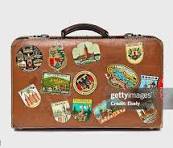
I remember the cases my parents had as they chugged their way back and forth from Lisbon to England. Brown leather and white leather cases littered with exciting looking labels. The RMS Andes is the ship that took us back and forth. I don’t remember having a case of my own – not like today’s children with Peppa Pig cases and pretty cases on wheels and now cases with wheels AND a scooter attached.

Then going off to boarding school. My mother packing a trunk that would go ahead of me on the train to Dorset It was a big old thing. Probably a good 3ft by 2ft? What on earth did she put in it I wonder. But I guess I was going to be away for the whole term

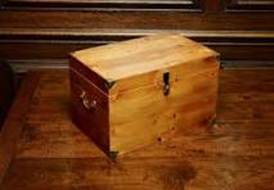
Then there was the tuck box. A sturdy wooden box into which I secreted sweets, toys and personal things like my diary and books. This carried on right through my teenage years, of course, going back and forth to Wiltshire.
What amazes me is how long it took the human race to put together two items that had existed for millennia – the suitcase and the wheel. They certainly hadn’t managed that moment of invention when I went on my first solo trip to France when I was 14. My parents went through an agency called En Famille where you were basically a paying guest in a French family. I was put on a plane at Gatwick to some tiny airport near Calvados, northern France. No-one was there to meet me. I sat in the tiny office of one of the airport staff while they tried to contact the family I was staying with. I remember feeling both embarrassed and anxious.
Hours later he eventually came but when it was time for me to return to the airport they sent me off on the local bus. I can still remember it now, having to change twice, once in Caen, and trying to find my way across unknown French city streets on a hot sunny day lugging my big case – with no wheels – across town to find the next bus stop. Thank heaven I got back to the airport in time for the plane. Looking back on it I think that family were irresponsible, just in it for the money. There was no French conversation or education, as mealtimes were spent watching William Tell dubbed into French.
Now that I am decluttering, I shall have to be ruthless. But which one to throw out? When I look at each case I can see I might still need it because “what if” x happens then I might need that one and “what if” y happens then I might need that other one…so I’d better keep them all hadn’t I, “just in case”?
I’ve known some. For my infant son, my parents, sister, grandmother, aunts, cousins, friends, marriage, relationships, pets and most recently my cat, Chico. There was a poignant discussion on Woman’s Hour recently about the depth of grief one feels for a pet and the complex emotions that go with this. After all, it’s only a cat, right? And yet a pet shares one’s daily life, moods, routines and rituals in a way that close friends don’t. Even in a marriage or relationship each one of you relates to that pet in different ways. And when you live alone the intensity of that relationship with your pet is inevitably ramped up.
And so if I have been rather quiet on the blog front it is because my cat Chico had to be put to sleep recently and I have been knocked for six by this. He was the second cat I have held in my arms while he went peacefully to sleep and each time I hoped that the Assisted Dying Bill would be passed for we humans, who may be put through far worse traumas than an animal at our death. I’m not optimistic that the Bill will go through.
The distinction with Chico is that he has been a part of my life after retirement. A period when one is less busy, less preoccupied with work or colleagues or family, as one’s family are now happy independent units to themselves – which is what one would wish for them. And so the fact that your cat bothers to greet you at the door when you come in, sits with you as you watch Slow Horses and insists on wrapping itself around you as you try to sleep takes on a greater significance than it would if one was busy with children or work.
A friend commented that she was perplexed when people express surprise at how grief impacts them and yet each loss is so unique that it is inevitable that each grief hits you in an equally unique way. One hasn’t lost a mother before, then a father, or vice versa. Each friend represents a unique relationship that has brought out aspects of oneself one may not have shared with other friends. And at my time of life losing friends happens horribly often.
People imagine that death was more commonplace emotionally in times when half one’s children would have died from illness and yet letters and diaries suggest that each loss was deeply felt. It’s human. Where there was love there will be grief when there is loss. I am aware that I witnessed my mother losing friends in old age and perhaps had a similarly misconceived assumption that it was easier as you got older because it is surely inevitable. But, of course, it isn’t easier. Your friends are immensely important at any stage of life but perhaps particularly as you age, for they know and understand you well and they also understand the challenges of ageing.
Another type of grief is experienced with illness or dementia, where I am witnessing friends losing the person they love – spouses, parents, friends – before they actually die. Stages of grief slipping into daily life as an illness chips away at a loved one.
I’m not sure one ever fully recovers from the death of a child. Nearly fifty years on it is still important to visit my son’s grave and keep the memory of his nine short weeks of life alive for myself and the family. And all those whom one has lost live on inside us. I’m not alone in thinking of my parents, sister and grandmother every day, and of missing the conversations I would have been having with them and with the friends who have died before me.
I was with both my parents, my son, and my sister as they left this life. And my two cats. Each one a precious being in this world, leaving this world. Perhaps I shouldn’t feel so surprised that Chico’s death has hit me this hard. The house feels echoingly empty without him. But this makes me think of other friends who have recently lost partners with whom they have shared the whole of their adult life. How can it possibly be comparable? In most ways it can’t and yet I still remember the day my father returned from the vet having had to put our golden labrador down and seeing him cry for the first time. I was probably around 10. These creatures certainly find their way deep into our hearts.
Although it is sad and uncomfortable, at the same time to grieve is to live, to feel, to appreciate what one has been lucky enough to enjoy and experience as part of one’s life: the love of a parent, sibling, spouse, friend, or pet. As Khalil Gibran wrote “You are weeping for that which has been your delight.” How lucky are we to have experienced that love and delight. To grieve is to be human and to be thankful.
Poems on https://www.babyboomerpoetry.com/poems/goodbye-chico/
Politicians often tell us that “diversity is our strength”. It sounds reassuring, but it raises an important and, in my view, rarely explored question: diversity of what, exactly? Perspectives, values, behaviours, customs, languages, ethnic backgrounds, religions – or all of the above? The answer matters, because different kinds of difference are not equally easy to weave into a socially cohesive whole. If diversity is genuinely to become a strength, leaders must articulate far more clearly to us what they mean by it and how they intend to make it work.
Some forms of diversity sit comfortably alongside one another. People from varied ethnic backgrounds may share a religion, a political outlook, or a commitment to common laws and customs. Others may hold very different beliefs yet still agree on basic civic norms. The challenge for leadership, whether of a country, community, congregation or organisation, is not simply to celebrate difference but to be clearer how a population with diverse histories, beliefs and practices can be united sufficiently to function as a stable, cooperative society. Recent surveys have suggested that Gen Z are experiencing loneliness and isolation and also that few feel proud of this country, nor would fight for it. A leader needs to provide a goal, vision and strategy that people of diverse ages and backgrounds can buy into and then inspire them to unite and go on that journey with them.
My suggestion would be to start with what we have in common. Across cultures we live in families, seek meaning, have dreams and aspirations for ourselves and others. Peace, economic stability, functioning institutions, good health and educational systems benefit us all. In an era of intense focus on multiculturalism, it is easy to lose sight of our common humanity, yet it is precisely here that social cohesion begins.
Respect for difference is often presented as a central requirement of living together, and being open to listening to alternative views is indeed essential. However, respect cannot mean the suspension of hard-won legal and moral principles. Politicians who appear willing, in the name of change or multiculturalism, to tolerate practices that undermine women’s rights, equality before the law, or protection from violence risk alienating large sections of the population. Even those who disagree with a leader politically tend to respect clarity of principle and the willingness to defend social and legal advances. After all, this is how civilisations are created – by building, generation upon generation, on what is learnt and developed over history, in the form of knowledge, science, medicine, technology, culture, music, art and wisdom.
These achievements were not inevitable and they remain fragile. Protecting them requires leaders who are prepared to state plainly that while beliefs and customs may differ, the legal framework and basic rights within a society are non-negotiable. However, many politicians appear reluctant to speak up on this. Freedom of speech itself feels increasingly constrained even for those in government, and difficult subjects are often avoided for fear of causing offence. Yet no problem can be addressed if it is not examined honestly, put under the laboratory lamp, investigated, analysed and subjected to a multitude of potential solutions. If a problem is pushed under the table and not discussed objectively it will never be solved. Open, evidence-based debate is not an act of hostility towards any group but a prerequisite for maintaining public trust. Without trust, and some sense of belonging to a land we value, we lose the sense of our shared humanity and too easily divide into factions.
In a short, myopic and complacent moment, we thought we had come to the end of history and that liberal democracy would be the future. Yet from the erosion of women’s rights in parts of the Middle East and Afghanistan, to religious violence in Africa and the rise of authoritarianism more broadly, we are reminded that we cannot take democracy for granted. The huge demographic change that has taken place in many countries over my lifetime has altered the assumptions that once underpinned everyday social interaction. The values, norms, customs, relationships and perspectives of individuals differ significantly from whether they were born in London or Delhi, Jeddah or Lagos, New York or Beijing. As the psychologist Professor Steven Pinker has observed, societies rely on a degree of shared “common knowledge” – unspoken understandings about norms, laws and customs, including humour. When those assumptions fragment, cooperation becomes harder.
It is time for political and religious leaders alike – across all faiths and none – to help us shape this evolving society. We need more leadership as to how we now think about ourselves, in order to collaborate for the good of the individual and the community as a whole. We can’t let diversity tear us apart so it is time for leaders to demonstrate, in practice and not just in rhetoric, how that strength of which they speak can be achieved. How, if we disagree about politics, theology or culture, we can still commit to a shared life in a social community, that is grounded in mutual responsibility and where the benefits of diversity are transparent and can flourish.
Diversity can be a strength when one is problem-solving. I have witnessed in jury service and in business environments, times when different perspectives, drawn together openly in a creative process, such as Edward de Bono’s Six Hat Thinking or as described in Matthew Syed’s book Rebel Ideas: The Power of Thinking Differently, can produce insightful results. However, there must be sufficient common ground and understanding to ensure that in that process people are indeed on the same side and have the same goals and intentions. This takes care, sensitivity and leadership.
To unite a whole country or community who have diverse beliefs, cultures, customs and histories a leader needs first to remind us of our common humanity, then motivate us to unite in shared goals. I have not seen this kind of leadership anywhere in the world so far. I truly hope I shall witness more of it in 2026.
Lisa Nandy suggested the other day that people were just getting on with their daily lives and not speculating about the budget. How arrogant this is and how disconnected from the fact that most people are very much concerned about the budget because it impacts their livelihoods.
The country is in paralysis, overwhelmed by the endless confusing messages coming from No.11 about the future budget. One day it’s income tax rises, the next it’s pensions, the next it’s a ‘mansion’ tax (although most ‘mansions’ in London and the South East are actually simply Victorian terraced or semi-detached houses that are far from being a mansion), the next it’s inheritance tax. Everyone is in the firing line.
These messages are generating fear and fear is the last thing people need, considering the government’s main message when they came into power was to promote growth. You can’t start a business, grow a business, or innovate if you are in fear. You need optimism. Without it no one would start any new venture.
But the attitude of Reeves and Nandy suggesting people aren’t taking notice of the budget reflects the unhealthy relationship we have to money in this country, as if money is a dirty word and those who make it become the “filthy” rich. But of course all of us are interested in how tax decisions will impact our ability to pay our bills. Wouldn’t we all like a little more money than we currently have? To pay off a mortgage? Feel secure on the rent? Take a few days’ holiday? Buy something for your child, parent or partner? Mend the leak in the roof? Most of us would.
A recent Times survey showed that almost no one feels they are rich because we all feel we are just struggling to pay our bills. The consequence is little growth because we can’t go to the shops and support the businesses on our high street, let alone other luxuries. The number of true millionaires or billionaires is miniscule – but if they, and other wealth creators, leave the country we shall be the worse off as they employ people, spend money and – which few people give them credit for – give large amounts to charity. Without those charitable donations much good work will be lost, and the State can’t afford to support the work these charities provide.
In a similar survey, the majority of people seemed to think that if you were reasonably wealthy it was down to ‘luck’. What an extraordinarily short-sighted perspective. Do people not realize how much time and effort is put into creating and running a business? If you set up your own company, however small, you spend 24/7 thinking about it, taking responsibility for the salaries and mortgages of your staff, watching competitors and the markets, and have often mortgaged your home to get it started. Whilst luck plays a part, it is the very unusual company or wealth that has been created other than through hard graft.
I think of Mark Knopfler’s song The Scaffolder’s Wife
“…don’t begrudge her the Merc
It’s been nothing but work and a hard life,
losing her looks over company books …”
Those who have gone into politics or the civil service straight from school or university have no experience of what it takes to keep a business going, to pay the bills and provide a good service. The reality is that if we chastise those who build businesses, employ people, make a success of it, then this country is going to go bust. The average salary is around £38,000 per year so if we lose those who earn more surely there is going to be very little tax to pay for the NHS or potholes, education, infrastructure, police, benefits or defending our country from hostile states.
We need aspiration. We have a major problem of several million adults out of work and high youth unemployment. To have growth we need to encourage these young people to believe that work is fulfilling, that making money and taking responsibility for your life gives you confidence and a sense of purpose. We need to encourage people to have ideas, to work hard, to put their all into work for themselves and the country. But when those who reach success are then denigrated, it puts young people off, how can it not? If we say wealth is a bad thing because “we don’t want those rich people anyway” then we are telling young people not to put their head above the parapets to try something new, to push through the challenges and make money, pay taxes but get a just reward.
We also need to recognise that not all human beings are the same and do not have the same motivations. Every country seeking growth needs to nurture that percentage of the population who have ideas, who can see a need that others haven’t seen, who can spot the way the world is going, the way science is developing or the economy is shaping up.
The history of the human race is punctuated by those people who have had a good idea and made it happen – in science, medicine, technology, manufacturing and more. We need the wealth creators, the business creators, the employers and innovators. You can bet that many of them may have had ADHD, busy minds that came up with ideas ten to the dozen. And, of course, those innovators need teams with diverse skills and temperaments to help them make it work.
We need to be encouraged to work, to save for a rainy day and save for our pensions rather than being threatened with having our savings or pension pots raided when we have done the sensible thing with our money. Businesses need to be encouraged to employ people rather than be taxed too highly or burdened with over-complicated regulation for doing so.
If those who are in power don’t understand that we have so many people in this country who have built small businesses and are working hard to make them profitable and are therefore very much preoccupied with what Rachel Reeves is saying, and is about to say, then they don’t understand their voters. These endless statements about the budget are limiting creativity and innovation, demotivating the solution-providers. We risk becoming, in Hayek’s words, “serfs” where the State takes over and our freedoms are reduced through being ground down by fear and lack of resource. It is the road to authoritarianism if we aren’t careful.
So let’s take our hats off to the scaffolder and his wife, and others who work hard and get both fulfilment and wealth from doing so because that wealth pays our taxes and funds our charities. And may Reeves, Starmer, Nandy and others respect the fact that those of us who vote do take a very real interest in the budget because it impacts our lives in fundamental ways.