
The lead-up to the election has been an extraordinary and distressing period. The tragic and terrible terrorist attacks have left us feeling numb, sad, confused and inevitably somewhat fearful for ourselves and our loved ones. There is no obvious quick fix for the challenges we face. It’s not obvious what we need to do about terrorism, BREXIT, defence, the NHS and education. Yet our politicians pretend they have the solutions when they don’t.
And the scepticism that Jeremy Corbyn would never win the election is also being turned on its head. The unthinkable is becoming possible as other parties have led appalling campaigns. A far left Marxist and his even more far left Deputy John McDonnell and Diane Abbott could be in charge of this country from this Friday. Personally I think this would be a disaster. I sit in the centre of politics and it is his anti-business stance that concerns me most. Where does that leave aspiration? The UK is one of the most entrepreneurial countries in the world and consists mainly of small and medium-sized businesses founded and run by enterprising and hard-working people who have often grafted for 60 – 80 hours a week, seven days a week, to get their business going.
There are major organisations, for whom he has it in, who employ large numbers of people but he wants to tax and regulate these until the pips squeak – and that will be likely to have the consequence of more unemployment and less tax revenue as businesses can and do, in this day and age, relocate to other more business-friendly lands.
On top of the upheaval and uncertainty of BREXIT – and Corbyn was remarkable for his absence in the Remain campaign and has held anti-EU sentiments that are unlikely to be beneficial to us in the negotiations – this anti-business approach could bring our country to economic ruin. Look at Venezuela. Or Cuba – yes they had good health and education but the people were dirt poor, and repressed. And financial ruin hits the poorest the hardest.
Corbyn supporters see him as the answer to our problems but I am not so convinced that his heart is in the right place, or that what he promises is affordable. They call him our Obama. But he is no Obama. It is trendy and hip to be pro-Jeremy – just look at the comedians, the TV audiences for debates, the celebrities. Social media streams are pro-Corbyn and few dare stick their head above the parapet if they feel differently. Those who utter criticism are regarded as unenlightened.
I know many of you disagree with me but I see him as a populist, our version of Donald Trump, albeit a very different character. He is an angry rebel – standing against situations for most of his life rather than for anything specific. What he does stand for, such as pacifism, his support of the underdog such as the IRA or Hamas, he later finds some way to wriggle out of in interviews so as not to sound too extreme. But I believe he is extreme. He is an ideologue who wants revolution and revolutions seldom end well and always incur much suffering and repression.
Inevitably the young will be enamoured with such idealistic rhetoric. I would have been if I had been younger. I flirted with communism in my teens in the 60s until I realized the terrible things that occurred in its name, the slaughter, the repression. Of course they will vote for him as he has effectively bribed them with the promise of no tuition fees. Why wouldn’t they? But whilst it is right that the young should be idealistic we also need to recognise that they have not yet had the experience of working, paying taxes, raising families and the inherent challenges of adult life.
But where to put that cross? The other parties are not offering us anything nearly as attractive. Of course not. They can’t. They don’t live in an idealistic wonderland. Perhaps you are old enough to remember the nationalised industries. I certainly am – the dreadful British Rail, the strikes of the 1970s where rubbish piled up on the pavements, we had electricity for only a few hours a day, bodies were not buried. Why do we imagine that the Government will be better at running industry when they have demonstrated through successive governments that they have been unable to run the NHS or education in any coherent or efficient way? Again, Corbyn is selling us a dream and of course people like dreams.
But we live in the real world. We have to pay for what a government promises. And if we go deeper into debt we have to pay more interest – billions of pounds of it a year that could be going elsewhere. Yes, austerity has been too harsh but we also have to be the grown-ups that we are as a voting community and recognise that money doesn’t grow on trees. We also need to recognise that it is a good thing to encourage people to work if they possibly can as this gives them pride and self-control.
I have voted Labour in the past but dislike the divisive rhetoric of the party. Words such as ‘the rich’ and ‘posh’. We need to encourage business development and wealth creation as these employ others and pay a huge percentage of the tax that our country needs for infrastructure. As do corporations. The ‘greedy bankers’ consist of a small percentage of people. The majority of staff working in organisations are decent ordinary people. You get rotten apples in every profession – we have seen cases of rotten doctors recently, we get rotten lawyers, rotten teachers, politicians, union leaders, etc. I am not an economist but I can see that one can’t allow banks to fail because each and every person who has money held in those banks, individuals and businesses, would have lost their money. There is still work to do on the culture and values of big business and I believe all the parties are addressing this. Things are changing and people in business are not all bad. In the meantime the coalition government and Conservative government who have been in power since the economic crash of 2008 have had to deal with the problem of “there’s no money left”.
Somehow we don’t hear the same criticism of ‘the rich’ for those who have made money singing a pop song or kicking a football. The anger and hatred is directed at business and this is dangerous because a country thrives or starves on the success of trade. My rather cynical mind thinks that a Corbyn approach is to pack full the public sector and keep people on generous benefits because these are his voting community and he has less control of them if they are working in the private sector. If he gets in I hope I shall be proved wrong but right now I am concerned for the economic viability of his policies.
I don’t have solutions. I think the Conservatives have made and continue to make major mistakes. I question how on earth the second referendum promised by the LibDems will work. Do they intend that many hundreds of people spend time and huge amounts of money discussing and negotiating an exit deal and then give the British public the right to reverse the whole thing? How would that work with the Europeans? Would they be happy that they had just spent two years of uncertainty that was effectively in the hands of the British people to negate? And how can any of them state that they will stay in the single market or custom zone until they start negotiating, especially when the EU will not flex one inch on the free movement of people?
But I do worry that a Corbyn government would ruin businesses and lead far more people into poverty. It will make the UK far less attractive a place for international businesses to operate – on top of the uncertainty they are already experiencing through BREXIT. Trade is what keeps the peace, not idealism. Trade has power in itself to build relationships, to employ diverse peoples and to keep the wheels of life going for the average person even through war and pestilence. Look at how mobile phone companies keep people talking despite wars, air traffic controllers and airlines maintain flights over and into war zones.
We have tax avoidance in the cash economy, such as in construction, and in the big businesses and this needs to be addressed. Business can be a force for the good, not evil. The average working person is just trying to make a living, not fleece others. Without it there will be no taxes to pay to help those people who need help – who are sick, disabled, or have fallen on hard times and need help and support to pick them up again. We need a Prime Minister who sees how to provide support for the needy in an efficient and pragmatic way. Anyone promising snake oil remedies must be questioned, their motives and solutions analysed to see if they are indeed workable.
Personally I believe the Coalition worked well for the country and I would like to see more cross-party projects on defence, the NHS and social care, on education. Collaboration surely provides a forum for listening to other perspectives and for rational debate. It has the potential to put the interests of the people and the nation above party politics. But the parties are claiming they will not work in coalition, so we have to make our own decisions who to vote for and this is difficult.
All politicians are human and therefore flawed and fallible. Think of Trump and how that was also a really hard choice of two people, neither of whom were popular, but I personally would have felt the US and the world to be a safer place with a pragmatic Clinton rather than the salesman Trump. Recent elections in France, the Netherlands and Austria have provided difficult choices for their electorate too.
Vote. Do vote. Don’t let the challenge stop you going to the ballot box. If you meet anyone who has lived under a repressive or authoritarian regime you will know how precious a gift a vote is. But please don’t fall for the line that all business is bad. It isn’t true and such propositions are bad for our country.

“A reader lives a thousand lives. Someone who doesn’t read only lives one.” George R.R. Martin
I was saddened to hear in a radio discussion last week that approximately 40% of prisoners are functionally illiterate. I was shocked that this reflects an educational system that must have been incapable, over many different governments and decades, to enable pupils to leave school able to read. If one takes the message of the quotation above, this leaves each of those individuals with only one life rather than with the possibility of living many different lives. It leaves them stuck, often in a background with few advantages, without the ability to perceive the options available to them to start a different way of living. We are letting them down.
Prisoners who can’t read are unlikely to get a job. If they don’t find work it is 90% more likely that they will re-offend, which is likely to cause harm to those against whom he or she re-offends, represents a personal loss of freedom, and is a huge cost to the taxpayer. Reading is a key that opens up opportunity.
So this got me thinking about reading and whose responsibility it is to raise the level of literacy. Of course reading is taught in school and is the business of government and the Department of Education but it also needs to be encouraged in the home. It is the responsibility of all those raising a child – teachers, parents, grandparents, aunts and uncles – to encourage and help that child to master this essential life skill.
It isn’t always easy to motivate a child to read but in my experience the earlier one makes it a part of daily life the more easily it becomes a habit. I have always been a bookworm, as was my mother. From an early age I have lost myself in magical worlds, adventures, and ideas. I feel I have lived in different countries, taking on the lives of the characters I was reading about, whether in Russia, Africa, Peru or on another planet. Each new chapter opened my mind to new ways of life and perceptions beyond those I had been taught at school.
It is easy for any of us to get out of the reading habit. When I was busy with small children I didn’t find the time to read as frequently, although I was re-reading my childhood books to my sons and now read to my grandchildren. I am also thrilled to see my six-year-old granddaughter wolfing her way through book after book since she learnt to read.
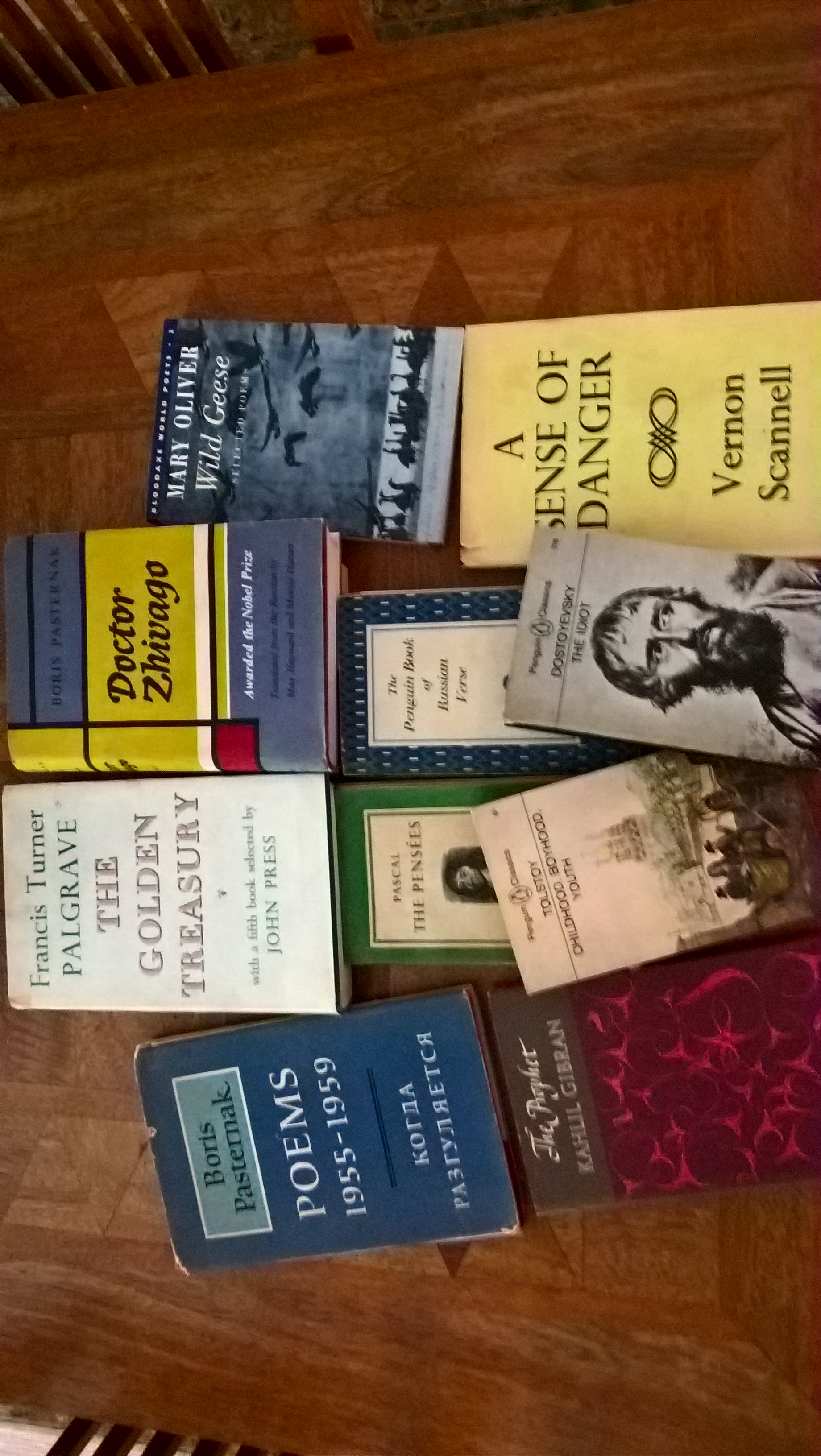
I am delighted to have more time now, as a grandmother, to return to reading. This has made me reflect on the fact that so many of the books we read, both classics and contemporary, that influence our minds and our lives, are read before we have even begun to live life ourselves. I look at the books on my shelf, which I feel tell the story of my identity, and realize that I read many of these as a teenager, at a time when I knew nothing of the many experiences of which the authors were writing. And yet their ideas broadened my mind and helped me develop knowledge and understanding that I may not have achieved without them.
For me the Russian writers have been, I think, my greatest influence, writing as they did in the context of a historic or political setting and yet bringing events down to individual human experience of love, family relationships and friendships. Sadly I can’t express myself as well as a Tolstoy or Pasternak!
At school we are generally given a reading list and I was interested to see that Andrew Halls, the Head teacher at King’s College School, Wimbledon, has recently developed a specific reading list for his pupils that he believes can develop empathy in the boys, beyond what they experience in their digital games such as Minecraft or ninja turtles. He has chosen books he considers to have complex characters who are leading believable lives. “From their interactions and choices,” he said “children can learn to understand and interpret people’s motives and feelings”. Agree with his choices or not, I suspect that we can all relate to having read something that made us cry or made us angry, even though we knew the character was fictional. This affinity we feel for a character expands our insight into other people’s lives and can develop not only empathy but also compassion and can help form the values we embrace as we grow up.
I hope that this simple but essential skill of reading continues to be taken seriously in schools and institutions. We are better informed of the kind of difficulties children have in learning to read, such as dyslexia – in my schooldays children were just regarded as dim which was a terrible restriction to the opportunities available to them. Thankfully today dyslexia is better understood although even now I am aware that it can be difficult to get a child tested early enough to catch them before they lose confidence or interest. I am glad that Richard Branson has recently been promoting the fact that he has been thoroughly successful despite his dyslexia.
So, as I choose now, as we move house, which books must stay by my side, I am also selecting which books I shall read again now that I am mature and have lived more of life. I share with you a poem, Anthology, I wrote about the poems and books that have influenced my life. Perhaps this will stimulate your own reflection on which books you wish to keep by your side, possibly to read again.
Who’s that knocking?
The poets. And I, the listener,
open the door of my memory
to the sense of a book in my small hand,
the delight of being ill, off school,
a mild ailment, tucking myself in, under the cover.
I recollect the yellowing paper, a dry touch to my finger,
the smell of the pages sucking me in,
allowing me to lose myself,
spin scenes from the words.
Who’s that knocking?
It started with Walter de la Mare.
What’s that buzzing in my ears?
Jack Clemo’s Christ in the Clay-Pit
that opened my eyes to the sacred.
The fading inscription from my parents
in The Golden Treasury that sits on my shelf,
a gift on my confirmation, aged fourteen.
The thumbed pages that flap open
to Byron, Lawrence, Wordsworth, Yeats.
Happy those early days when I read
but had not experienced the touch of a lover,
the pain of a parting with silence and tears.
I scour the pages now and ask, where was Blake?
Who’s that knocking on the window,
pushing it open to consider the night,
to look at the stars, look at the skies?
Pascal, whose Pensées let in the light
to previously shuttered views of perception.
My father’s gift, three shillings and sixpence.
Pascal’s universe “an infinite sphere,
the centre of which is everywhere,
the circumference nowhere”
blowing my mind,
forcing me to reflect on infinity, on man with or without God.
About suffering he was not wrong.
Who’s that pricking at my conscience?
The dusty blue book some fifty years old
still read, Pasternak, hammering always
the need for the heart of the matter,
the quest for a way, fame not a pretty sight,
success not your aim.
He the one who set my pen rolling
to emulate his words, his life,
with my teenage poetry,
still shapes my words and views,
whispers in my ear not to be an empty name
to defend my position, to be alive, myself.
Who’s that crying?
I saw my infant son die a few weeks after he was born,
Charles Lamb’s cradle-coffin verse of doom perverse beside me.
I shattered the cosiness of family life with divorce,
yet the stars have not dealt me the worst they could do.
I have travelled among unknown men,
visited fifty countries or more, through heat and dust,
through ice and Arctic Circle; Yevtushenko’s Russia,
Leopardi’s Italy, Goethe’s Germany,
and walked with Gibran in the Lebanon,
sat with Mary Oliver enjoying the sharpness of the morning
in New England. Seen that poets must loiter in green lanes.
Who’s that knocking on the door?
The chattering of the beat poets
howling their way through the entrance in the garden wall,
while I hide beside the hollyhocks
with the Romantics at my side.
I re-read my early poems in their schoolgirl script,
interspersed with Vernon Scannell’s notes in the margin,
laugh and cry with Copus and Cope,
leave Motion untouched in the bookcase,
switch off McGough on a Sunday afternoon,
and wonder which poet will next direct my hand,
enflame my heart.
Well, the gloves are off and we’re in the Brexit ring with no referee. I am heartened to hear more calls now for an objective non-European mediator in these talks. Meanwhile I have been pondering on the themes of disillusion and delusion. I suspect there is disillusionment on all sides right now as we read of what is described as an “inauspicious beginning” to the Brexit talks. At the same time we have probably all, both Brexiteers and Remainers alike, been deluded in some ways during the Referendum campaign: Remainers taking the outcome for granted by only focusing on the negatives of Project Fear rather than articulating the benefits of remaining a member of the EU; Brexiteers potentially being deluded that the process would not be as disruptive as it is likely to be.
This morning I read a passage from Slavoj Zizik’s Living in the End Times (2010). Zizik talks of how liberal democracies have, in the name of tolerance, been persistently blind to the truth that lies before their eyes. He suggests that the more such a group has invested in the current order the more willing they are to uphold the lies. It is only the dispossessed who can tell things exactly as they are, since they have nothing to lose.
This made me consider how leaders in the UK, Europe and US have been deluding themselves over many decades as to the sentiments existing within the populations they were governing. Throughout these areas those who voiced a concern about the way their country was being run were patronisingly dismissed as ignorant or unenlightened. But, as we are seeing with the events in the UK, US, and much of Europe, when those in power high-handedly ignore legitimate concerns, the voices rise up ever more fiercely, as we are seeing in the French election.
Right now it is Theresa May who is in the negotiating ring. She is bearing the brunt of this populist movement and its outcome in our country and I don’t envy her one bit. Like her or not, support her or not, she didn’t vote for Brexit but stepped forward and is tasked with the responsibility of endeavouring to make the best deal she can for the UK. Whatever our political colours – and I am not a party-political-animal – it is in all our interests that these talks are successful for us and for our allies. It isn’t a time for sniping, it is a time when we need our leaders to be wise and act in the best interests of the world and those they govern.
Of course May and her team have made mistakes as they enter talks. It is easy for Corbyn (who is presenting himself as the hero of Remainers despite being near invisible during the Referendum campaign) and Farron, on the sidelines, to point fingers and say what they would do differently. But I am not convinced that they would be any more effective negotiators themselves. And the leaders of all the parties, together with the leaders of the EU, have played their part in getting us to this point by deluding themselves that those they governed were more content than they were with the status quo. It would be good to see some humility being expressed with how wrongly they read this but I am not hearing it.
Juncker may say that May is deluded but quite frankly, as Emmanuel Macron is pointing out, those in Brussels have been deluding themselves for years in refusing to see the need for reform. In conversations on the subject, I have not heard any great enthusiasm for returning to an unreformed EU, even from those who voted Remain. It isn’t just the UK that has been disillusioned – there are plenty in France, Hungary, Poland and other EU countries who also see the need for reform, as Macron is now demanding, should he be elected President of France on 7 May. But, having failed to influence change in the years leading up to 2016, it was the UK who verbalised and acted on the disillusionment that many others were also feeling.
I for one am disillusioned that the leaders who brought their countries together in this alliance did not have the foresight to create a formal exit strategy that defined a just process of withdrawal. In business any contract bringing companies together in collaboration, mergers and partnerships includes a structured process of exit for those involved, just as the courts provide a fair strategy for exit from a marriage. Why has no one put this in place over these many years, I wonder? It seems incredibly irresponsible as any country wanting to exit (and while it happens to be the UK, it could have been any one of the countries) is basically held to ransom by the power and might of the union of so-called partners they are leaving behind. Would Juncker’s barbed remarks be so easily tolerated if he were describing the exit of a poorer country such as Bulgaria? How might Brussels respond should Frexit occur? Would they accept more responsibility for having created the situation, or would they continue to treat disillusioned countries as if they are the naughty child at the back of the class?
We shall surely seek a trade deal with the EU but I find the threats about how long this could take quite bewildering. Who benefits from delay other than the well-paid bureaucrats and lawyers tasked with these talks? Brussels almost boast of the Trade Treaty with Canada having taken twenty years, but surely this actually demonstrates an abject failure if a trade deal with a country like Canada takes this length of time to conclude? I accept that it is complex – but twenty years? This certainly hasn’t been a benefit for the tax payers of the countries involved who are paying the legal bills.
I have no great confidence in any of the negotiators involved in the Brexit talks, whether from the UK or the EU but some form of an alliance between our countries is of great value to us all – for trade, security, research, science, defence and friendship. The current posturing we are witnessing on both sides is certainly disillusioning and I hope that the tone will change to one of enlightened collaboration as talks progress.
My fear is that we are on the brink of a change that will benefit few but that those on all sides are too stuck and stubborn to flex sufficiently to resolve these complicated problems. Despite the unity shown between the remaining 27 countries at the Brexit meeting to agree principles on Saturday, Brussels nonetheless still faces the prospect of the challenge of disillusion from France and the Eastern European bloc. If they don’t take a good honest look at themselves and respond, we could still witness the break-up of the EU and they would not be able to lay the blame for this at the feet of the UK alone. Brussels would have to take responsibility for their own tardy reaction and intransigence. I hope that doesn’t happen. I hope that wisdom will prevail to make the changes necessary to maintain peace and cooperation in Europe.
There’s plenty to criticise about Mrs May’s approach but I wouldn’t wish to be her, standing as she does, totally outnumbered in the ring. It will no doubt be the steepest learning curve of her life and I hope that she listens to many perspectives and keeps an open mind to the possibilities and opportunities that profit all as the weeks go by. This brings to mind this quote from Theodore Roosevelt:
“It is not the critic who counts; not the man who points out where the strong man stumbled or where the doer of deeds could have done better. The credit belongs to the man who is actually in the arena whose face is marred, with dust, and sweat and blood…who, at best he knows the triumph of high achievement; who, at the worst, if he fails, at least fails while daring greatly; so that his place shall never be with those cold and timid souls who knew neither victory nor defeat.” [Excerpt from the speech “Citizenship In A Republic” delivered at the Sorbonne, in Paris, France on 23 April, 1910]
And of course I should mention, for the politically-correct requirements of our era, that although Roosevelt uses the word ‘man’ I see this quote as encompassing all of humankind …
I have been thinking about my grandmother recently. She was widowed young and this makes me recognise how fortunate we are, as older women today. We can travel and enjoy all of life in a way that she could not. There were far stricter social norms for a single woman, whether widowed or divorced, in earlier times. Even now friends describe how attitudes towards them change when they become widows, how men, in particular, offer unsolicited advice as if they are automatically incapable on their own and need protecting. Even Sheryl Sandberg, the COO of Facebook, described recently how she lost confidence when her husband died suddenly and she found herself alone. Neither career success nor wealth can protect us from the human experiences and interactions of everyday life.
Last week I went to an inspiring talk by Leah Thorn of www.loveolderwomenrock.wordpress.com at the Loose Muse women’s writers’ group in Covent Garden. As always it was organised brilliantly by the inimitable Agnes Meadows who is certainly an older woman who rocks! Leah’s poems were poignant, uplifting, funny and often subversive. They were accompanied by her fantastic collection of clothes, shoes and jewellery embossed and embellished by her poetry and integrating the creativity of several women involved in the Older Women Rock pop-up shops and exhibitions she is currently organising.
Inevitably it got me thinking about what it means to be an older woman. My mother, at the age of 82, used to describe to me how she felt 18 inside – until she looked in the mirror, or felt a twinge in a knee or hip, when reality would return. This will be a common experience for both men and women of a certain age, I suspect.
And yet much as we feel the same person as we were when we were 18, the truth is that it is not just our skin tone that has altered. Inside, on both conscious and unconscious levels, the building blocks of who we are have shifted position, changed shape, grown and maybe deepened. Whilst we may, as women, endeavour to smooth out all those wrinkles, the fact is that these wrinkles have painted the history of our inner experience on our faces. The laughter or worry lines, the sadness, anxiety or mischief in our eyes, the happiness, amusement or depression that plays around our mouths. Why do we feel it so necessary to wipe these out in order to please a society too strongly focused on appearance and so-called beauty? I could name some very attractive older women who have done nothing to hide their life story from their faces and are all the more beautiful as a result. In fact my old schoolfriend, the actor Dame Harriet Walter, produced a book of photographs on the subject of older women, entitled Facing It. It is inspiring.
We do, of course, leave some things behind as we age. I often catch myself looking at clothes that I would once have worn but have to accept would now neither fit nor suit me at the age of 66. Equally, though, I do remember thinking, when I was about 33, that I was “too old” to wear jeans, which was obviously ridiculous as here I am still wearing them. We can certainly pick up some weird ideas about the shoulds and should nots of getting old. I thoroughly enjoyed having my flat in Nice, as the French ladies on the Côte d’Azure refused to get old and still strutted their stuff with panache on the beaches of the Promenade des Anglais.
So as I declutter my wardrobe in preparation for moving house, I do feel nostalgic when I take some chic little number to the charity shop. And sigh a little as I remember those wonderful clothes we used to wear all those years ago from Biba and Bus Stop. I miss the covered buttons and long cuffs, the velvet, the puff sleeves, epaulettes, textures and colours of the 60s. And particularly, most particularly, my pale blue platform suede boots.
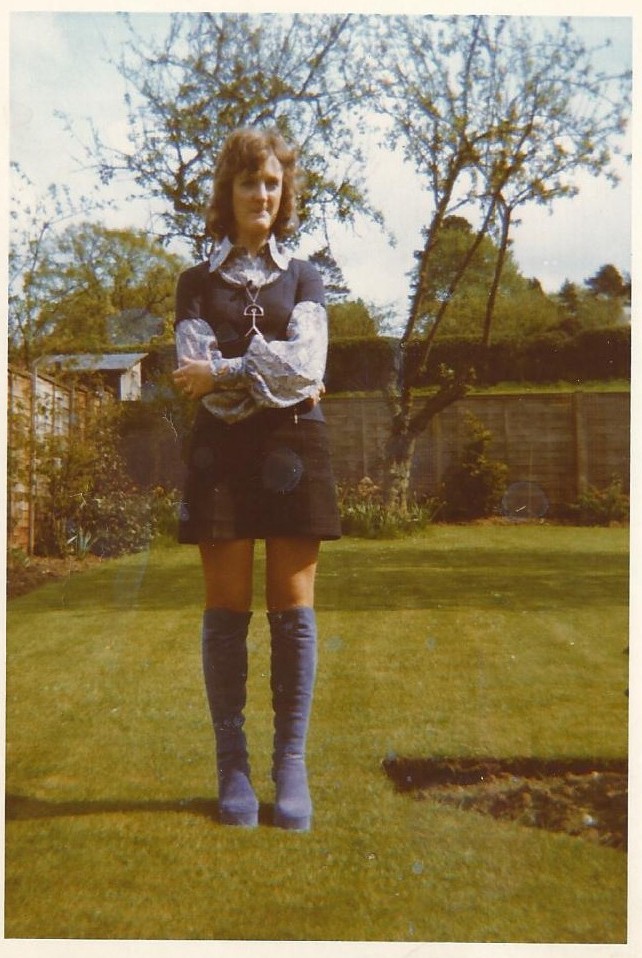
The attitude of society to older women can be rather depressing. We have to stop ourselves believing the rhetoric as otherwise we can lose confidence, influence and status as we age. We see fewer older women presenters on TV. Women talk of being invisible. But, as at any age, it is what you are feeling inside that makes the difference. Thinking of ourselves as invisible can be a self-fulfilling prophesy.
And then there’s money. There was a moment around 1994 when I woke up to the fact that I needed to take more responsibility for making and saving money for my old age. My co-author on Your Mind at Work, Richard Israel, recommended that I read a book called Smart Women Finish Rich by David Bach. It opened my eyes. There were case studies of women who had been ruined by making an assumption that their husband was managing their finances but then discovered they were up to the hilt in debt. It was full of good advice about saving money. We women can rock and roll and enjoy ourselves on relatively little cash – but hey, it is more fun if we have a little in the bank to make the choices that impact our lives. And when one makes it oneself it feels even better!
The years have hopefully taught us something. The idea of the wise woman used to be widely acknowledged and perhaps we need to reclaim some of that role. Others don’t have to act on what we say if they don’t want to but sharing an observation we believe in can be helpful – even if it is politically incorrect. But there is humility in wisdom, too, so it’s not about imagining we know it all. The young generally know what is best in the context of their own lives and it’s their time to make some of the innovations and mistakes we inevitably made too.
I may have lost some of the fun choices I had when I was younger – the mini skirts, slim waist and flexible joints – but I feel that I have nonetheless gained some serenity. At all stages of life, it is how one feels on the inside that counts. Where we focus our minds influences our moods. Thinking of ourselves as vibrant will give us a vibrant energy from the inside-out. When I want to feel young and upbeat I listen to music from the 60s. We have just been to see the musical Motown which reminded me of all those parties I went to in my teenage years. When I get anxious I can choose to relax and enjoy the innocence of a grandchild, the random smile of a stranger, the joy of watching one’s children grow up with their own families. And when I need peace I can focus my mind on the spring birdsong in the garden, or play some sacred music. I’m also fortunate enough to have some great role models as friends.
And yes we did rock in the 60s and still do. We were, in many ways, a lucky generation but we had our challenges and are certainly not the only generation to rock. I hope we can blaze a trail for older women and encourage the television stations to continue to employ older women presenters. With Theresa May and Angela Merkel out there demonstrating that women over 60 can represent their country on the world stage, there is some hope, whatever one’s politics.
Some poems on the subject on www.babyboomerpoetry.com
It’s been a dismal week for reading about violence perpetrated by men. We have read of IS using children as human shields, Mustafa Bashir hitting his wife with a cricket bat and making her swallow bleach (and, by the way, then only being given a suspended sentence by Judge Richard Mansell), the stabbing of Tracey Wilkinson and her son Pierce by a 20-year old homeless man, the experiences of the girls abused in Rotherham, paedophile rings, a husband who killed his children in an act of revenge.
These are not unusual stories. Men have been the dominant power throughout history and much of that has been spent in warfare. And of course communities benefit from the physical strength of men to protect them and ward off marauding enemies. But a UN report estimates that, worldwide, one third of women have experienced intimate partner violence or sexual violence by a non-partner. In Asia widows can be thrown out of the home, daughters subjected to honour killings or even a punishment of gang rape when they step out of line. Religious leaders have applied dogma to ritualistic abuse, control and cruelty. Young boys suffer from the hands of older men too and are only just beginning to talk of their experiences.
I would like to learn more about the drives that lead to these behaviours. I feel there is a need for greater research and debate on what triggers violence. Is it the biology of testosterone, cultural beliefs, or environmental context? If the psychologists have this information then it is not sufficiently available to the general public to be of practical help to those who raise and educate boys. Apart from chapters in Raising Boys by Steve Biddulph there seems to be little practical advice on how to enable boys to manage their warrior tendencies. The most I ever learnt about the subject, when raising my sons, was through reading The Secret Diaries of Adrian Mole!
Of course the majority of men do not behave in this way and women can be cruel and aggressive too but, even today, men have more power worldwide to disrupt individuals and societies. From what I have read, social upbringing appears to have more influence on behaviour than testosterone itself. Although the testosterone of violent criminals measured higher than average in research, when testosterone is given to normal sociable men they do not necessarily become more violent. But, whilst men are also great writers, thinkers, innovators, doctors, fathers and leaders, it is the tendency towards aggression that I believe we need to understand more fully.
Both boys and girls experience huge waves of hormonal change as they grow up. Girls have to learn to manage both their bodies and moods from puberty, through becoming familiar with the impact of their monthly cycles. They are given copious advice about how to manage this, as well as contraception, plus admonishments about not getting drunk, not behaving provocatively, or walking down the street in short skirts. When a rape occurs the censorious comment is aimed at the girl. I hear little advice given to boys on how to take responsibility for their own drives and biology.
An important book, South of Forgiveness, was released recently through the collaboration of Tom Stranger and the girl he raped, Thord Elva. It was telling that when interviewed on Woman’s Hour by Jenni Murray, she realized with surprise that having interviewed many women who had suffered abuse or rape, this was the first time in the fifty years of the programme that she had interviewed a man who confessed to being a rapist. What he and Thord Elva shared was insightful and went some way to providing information on what led him to delude himself that he had not raped her but, in his mind, had simply had sex with her. It was only many years later when she wrote to him and shared the devastating impact the event had had on her that he accepted that he had, indeed, raped her.
Since then, the pair have been interviewed in the media but have been subjected to protests that Stranger should not be given air-time to express his story. At an event at the Royal Festival Hall a crowd took over and shouted “rapist” and refused to listen to his personal account of the rape. The problem with this no-platforming of controversial figures is that we learn nothing. And it seems to me absolutely vital that we do listen and that we do learn more about what makes men commit acts of violence.
A key factor mentioned by Tom Stranger was a sense of “entitlement”. If this is the case, we need to be educating boys and young men that they have no entitlement over another person’s body and that they do not have consent unless it has been explicitly given. Unfortunately in much of the world, cultural tradition gives boys priority status, sometimes backed up by law. This can translate into a distorted view of their rights, and give girls a diminished view of their own. What Stranger has done is to encourage men to reflect on their own behaviour. Research so far appears to have studied mainly the experience of the victims rather than the perpetrators. Do we know what those men who raped women during the Bosnian war now feel as they walk around their villages?
Helping young boys understand the influence of testosterone is, in my view, an essential part of their education. They need to recognise that when their testosterone is raised – which can be by listening to loud music, drinking alcohol, watching porn or witnessing their favourite football team win – their brain loses the capacity to restrain risk behaviours. They are more likely to get into fights, to have a car accident, to bully or dominate others, or even to rape or kill. But a moment’s loss of self-control can devastate their own lives as well as the lives of others
Adolescents could surely benefit from learning the skills of impulse-control such as how to notice warning signs of anger or lust, to stop, self-calm, and manage their biology by applying techniques such as imagery, slow breathing, and rational thought, avoiding alcohol, going for a run. They can identify the underlying thoughts that lead to violence, such as “he/she must give me respect or else I’ll punish them!” and developing, instead, constructive perspectives, such as “I have no right to harm another person just because they aren’t doing what I want them to do,” perhaps accompanied by an image of a prison cell as a deterrent.
Aggressive behaviour is a natural element ruling animal life, where instincts are driven by survival and the preservation of the species. Sir Michael Marmot in The Status Syndrome suggests that man is shaped by evolution to seek status, affirming himself by trying to be distinguished and gain influence and power in career, sports and material assets. Generally this is through non-violent actions. But in fact it can be low status men who may resort to aggressive high-risk strategies to avoid “genetic nothingness”. We frequently hear that violence has been committed by a “loner” perhaps seeking notoriety or even a distorted view of closeness with another.
Helping boys develop constructive social networks is essential. It is the messages they receive from parents, society, teachers, preachers and particularly their peer group, that can give them self-esteem without the need to dominate others through violence.
We are more than our biology. Helping the young to understand how to notice and understand biological triggers, manage them and learn ways to express them more appropriately, particularly in a digital world, would surely be a benefit to societies worldwide. This may make uncomfortable reading but in order to address the issues, we need to be able to have mature discussions on the subject. Silencing debate takes us nowhere.
Today represents another historic shift in our relationship with Europe, as Theresa May triggers Article 50. This puts me in a reflective mood. My childhood echoed to the reverberations of De Gaulle’s “Non” as we applied to enter the Common Market. We finally joined in the 1970s, an era of strikes, the 3-day week, and petrol shortages. Later, in the 1990s, I was at King’s College studying history when the Channel Tunnel opened. The Tunnel left us less of an island nation than we were. This made us, as does any close relationship, both stronger and yet more vulnerable. I remember being in the middle of an essay on the Hundred Years’ War at the time and wondering what the opening of the Channel would mean for the role and security of the UK who, as that island nation, had fended off attack and occupation for so many centuries.
Much has happened since we joined, both positive yet challenging. Many Europeans have come to live and work in our country and vice-versa. Deep friendships and family ties have developed. These need to be protected.
But I worry about the way the Brexit negotiations are being set up. Theresa May has a daunting prospect ahead of her as representative of a single country in negotiation with 27 others. Who is going to ensure that the negotiations are fairly led? A few years ago I trained as a mediator and as such would recommend that the talks are carried out on neutral territory, with an objective facilitator, but I have seen no sign that this is what is intended.
What a pity that leaders on both sides have allowed communications to sink to insult and a sense of win-lose rather than win-win. What we need is statesmanship and leadership. The UK is not alone in some disaffection with how things were being run. A wise EU President would have brought the member states together long ago to explore what revisions were needed in order to adapt to the context of the 21st century. Acting early would have enabled all states to come together in a more positive and inspired frame of mind.
Instead, the parties are gathering as if they are boxers in a boxing ring. Each in their corner pumping themselves up for the fight. Barnier, Juncker and Tusk rattle their sabres in one corner threatening punishment, isolation and bills. May in her corner threatens to walk out if she doesn’t get a ‘good deal’ for Britain. I don’t see any referee.
This is surely a thoroughly dysfunctional way to start negotiations that affect millions of people in all our countries. What hope do we have if there is not a fair and objective mediator who manages these talks and negotiations?
EU negotiator Guy Hoefstadt has, just recently, talked of the emotional impact of Article 50 and its ripple throughout the peoples of all 28 states. There are strong emotions on all sides – anger, frustration, fear, uncertainty, sadness, grief, resentment, rejection as well as excitement, relief and a sense of opportunity. Who will help the negotiators create a safe space to express these emotions?
In the process of mediation there is a recognition that emotions need to be safely expressed before facts can be heard. If not articulated they will filter through in words and actions rather than being safely parked having been vented and acknowledged as legitimate responses to a complex situation of fracture, for which both parties bear responsibility.
Co-creation through mediation
It concerns me greatly that no neutral mediator has been identified to facilitate this divorce in such a way that is fair to both parties. In a marital divorce there is a well-trodden path of the law to ensure that there is an equitable result for all, practically and financially, and that children are taken care of in the most compassionate and supportive way possible. But who will be the neutral facilitator in the divorce coming up between the EU and the UK?
A mediator helps identify positive outcomes. The parties are encouraged to re-connect with shared vision and values and given a practical process to follow in order to work out the steps to achieve that result. This approach transforms boxing to aikido, knowing to finding out, defending to exploring, advocacy to facilitation, proving to creating, answers to questions, winning and losing to sharing. It is a very different, solution-focused not adversarial, approach.
Issues are identified and prioritised. A mediator also intuits what is beneath a statement, observes where there are hidden agendas or when someone is not saying something they appear to feel, drawing people towards honesty and collaboration. Diversity of opinion is enabled and ideas encouraged during the brainstorming phase, where many options can be shared in a non-critical way as they seek lateral solutions to problems. Options are only analysed and discarded after a reasonable period of open-minded discussion during which the individuals are encouraged to remain impartial.
In mediation there is space for each party to have independent time with the mediator in order to explain their perspectives, needs and wants before coming together. All that is said in those private meetings is kept confidential. The mediator brings the parties together only when they feel each party is ready. A safe space is provided where emotions can be vented and where each person is listened to without being interrupted. The process is flexible, without prejudice, with each party feeling in control of whether they agree to settle for a point or not. But it is the mediator who enables the process, who builds rapport and trust, and keeps the focus of the procedure on mutually positive outcomes. Without this the two parties too easily arrive at win-lose arguments that get them nowhere.
In the concluding phase both parties are assisted in agreeing a mutually beneficial settlement and making an emotional and practical commitment to honour the actions and behaviours required within that agreement.
I have not seen any mention of holding the talks in a neutral space, nor of an objective facilitator being appointed in the upcoming EU negotiations. I hope such a procedure is put in place and that those concerned with leading them remember the words of the 6th century philosopher Lao Tzu below in order to reach outcomes that take the UK and Europe forward into this unknown future in as mutually beneficial way as possible.
“The wise leader knows how to facilitate the unfolding group process, because the leader is also a process… The leader knows how to have a profound influence without making things happen… facilitating what is happening is more potent than pushing for what you wish were happening.”