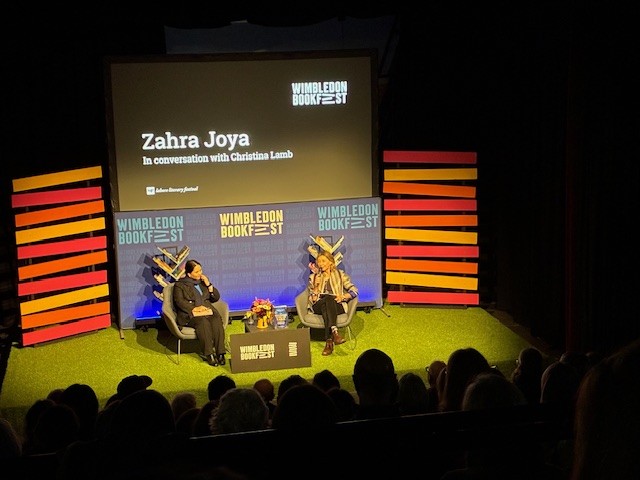
This is what Zahra Joya, the Afghan author of The Vanishing Girl of Kabul: Betrayal, Hope and an Extraordinary Fight for Women’s Rights, told the audience at the Wimbledon Book Fest last weekend as she was interviewed by the Sunday Times Chief Foreign Correspondent, Christina Lamb. And so, this is what I am doing. Again, as I did on July 29th this year in my blog “Why is the World So Silent on the Plight of Afghan Women and Girls?
I don’t know what good my writing will do but the fact that half a population of a huge country is effectively imprisoned, largely excluded from education, employment and public life, in this day and age, is something I find incomprehensible.
How come more is not being done to liberate these women? Can others not put pressure on the Taliban? Where are the voices of men, both within Afghanistan and across the wider Muslim world, who reject this treatment of their daughters, wives, sisters and mothers? Surely they, too, have a part to play in challenging the Taliban’s interpretation of Islam?
Zahra told us of how people commiserated with her parents at her birth. Why? Because they had had a girl. “What a terrible sorrow”. As a grandmother of beautiful granddaughters, I am horrified that people should respond this way to the birth of a daughter, but of course this isn’t just in Afghanistan. Throughout history, girls have too often been regarded as less valuable than boys, despite the immense contribution women have always made to their families and societies.
As Zahra explained, if there hadn’t been a great deal of misogyny in the country already, then the Taliban probably couldn’t have made this happen. There are small pockets of dissent among men, but those who protest risk being shot or imprisoned. And, we were told, the school uniform for boys now resembles a Taliban uniform so the brainwashing starts young.
Meanwhile these courageous and determined girls meet on secreted laptops in quiet rooms and basements. I attended one of these Zoom calls and heard about how each one of them is teaching others anything she knows – a language, grammar, mathematics, a sharing of knowledge between them. Kate Clanchy, the poet who mentors young Afghan girls in creative writing, was on the call and the girls in her classes produce the most beautiful and poignant poetry.
These girls are so articulate and impressive. They represent small battalions of resistance and hope. Yet hope only gets you so far. You need action to make change happen. It is beyond me to comprehend this behaviour or to believe that any religion would wish for half its population to be treated in this way. One thing is for sure, we should not accept any hint of coercive practices here.
So, what can we do? We cannot all change governments or confront the Taliban, but we can refuse to be silent. A war of words, of disgust and dismissal of the Taliban’s behaviour would be a start.
We can write to our MPs, challenge the iniquitous lack of media coverage, support those who are helping Afghan girls to continue their education, and make sure their voices are heard, read The Vanishing Girl of Kabul, if you haven’t yet done so, and share the work of Afghan women journalists and writers.
These young women are not asking us to pity them. They are asking us to stand alongside them. They are demonstrating extraordinary courage in circumstances that most of us can barely imagine.
Zahra Joya asked us to raise our voices on their behalf. Surely that is the very least we can do.